
I live in a hostel while pursuing my bachelor's degree in AI and ML.
If you've ever lived in a college hostel, you already know how the semester goes. On normal days, almost nobody studies. There are late-night conversations, cricket in the corridor, gym sessions and random trips for chai at midnight. Books stay closed.
Then the exam date sheet comes out, and the whole hostel turns into a library overnight.
The real problem with last-minute exam preparation is simple: there is never enough time to study everything. The syllabus is huge, the first paper is a few days away, and you're left with one question:
What is actually important, and what can I safely skip?
Normally, answering that question is a project of its own. You have to comb through the syllabus, ask seniors, dig up previous year question papers (PYQs), and figure out which topics keep repeating. By the time you finish filtering, you've spent the very hours you were trying to save.
So I tried something different. I gave the filtering job to AI.
Step 1: Using AI to find the most important topics
I started small. With a few structured prompts, I asked Claude to go through my syllabus and give me:
- a list of the most important topics for each unit,
- the most expected questions across the syllabus, and
- a clean important-questions PDF I could revise from.
This alone changed how I prepared before exams. Instead of reading every page of every chapter in order, I had a focused list to start from. I wasn't guessing any more: I had a revision plan.
Still, that wasn't the part that surprised me.
Step 2: The night it matched the real paper
One night before an exam, I borrowed an old university question paper from a senior, took a photo of it on my phone, and shared the image with Claude.
I asked it to study the pattern (the sections, the marks distribution, the types of questions, and which units carried the most weight) and generate a full mock paper for my upcoming exam.
Then the real exam happened.
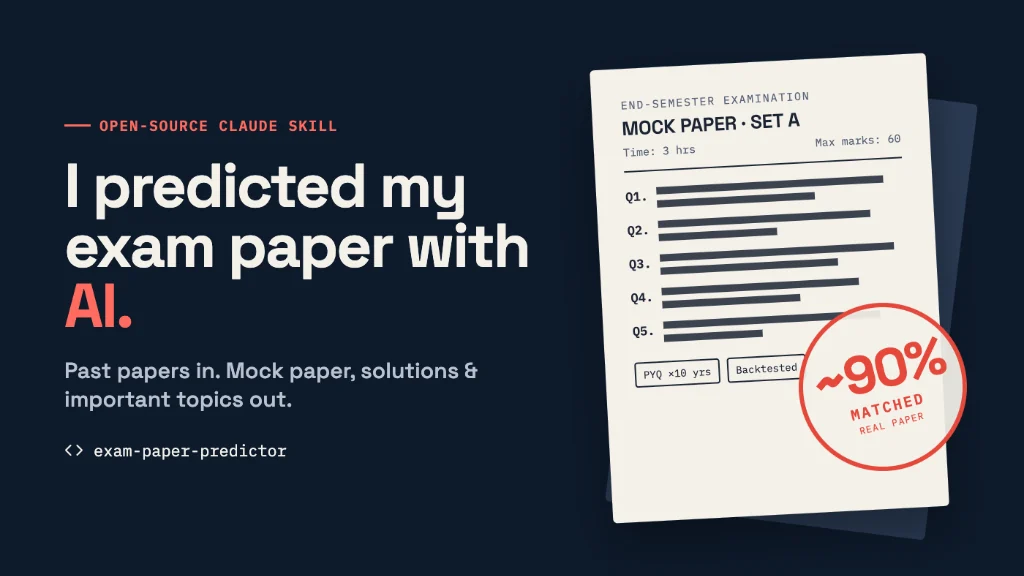
When I compared the mock paper with the actual question paper, the overlap was around 90–95%. Not word for word, of course, but the same topics, the same question styles and the same weightage. Questions I had practised the night before were sitting right there in the exam hall.
I want to be honest here: this was my experience on my papers, and one strong result is not proof that it works every time. Syllabuses change, examiners change, and some papers are deliberately unpredictable. Still, it worked well enough that I couldn't stop thinking about one question:
Why should only I have this?
Every student in every hostel faces the same exam-night problem. So I decided to package the whole workflow into something anyone could use.
Introducing exam-paper-predictor: an open-source Claude skill
exam-paper-predictor is a free, open-source Claude skill that predicts an upcoming exam paper from real past papers.
I didn't build it only for my university. It's designed to be universal, and works across:
- University and college exams: semester, midterm, end-semester, finals and resits
- School board exams
- Entrance and competitive exams
- Professional and licensing exams
It works in any country and in any language.
What the skill actually does
Here is the full workflow from input to post-exam grading:
1. Collect past papers       5–20 years of PYQs (found automatically or uploaded, including photos)
2. Map the exam pattern      sections, marks, question types, chapter and topic weightage
3. Backtest on past years    hold out a past paper, predict it from earlier years, score the match
4. Generate the PDFs         mock question paper, full solutions, and high-weightage revision sheet
5. Grade the prediction      compare against the real paper once the exam is over
1. Collects past papers. It searches for 5 to 20 years of previous year question papers on its own, or works with the ones you hand it, including a phone photo of a senior's old paper.
2. Maps the exam pattern. It breaks down sections, marks distribution, question types, and both topic-wise and chapter-wise weightage across the years.
3. Backtests its own predictions. This is the part I'm most proud of. Before predicting your upcoming exam, the skill tests itself on past years: "If I only had the papers before 2023, how well would I have predicted the 2023 paper?" You see how reliable the pattern is on real held-out papers before you trust it for your own revision.
4. Generates ready-to-use PDFs. In one run, it produces:
- mock question paper PDFs laid out in the real exam format,
- separate step-by-step solutions PDFs, and
- an important-topics PDF for quick revision.
5. Scores itself after the exam. Once the real paper is out, you can feed it back to the skill and it will grade how accurate its prediction was. That last step matters: a tool that predicts exams should be willing to be graded too.
Why past papers work so well with AI
There is nothing magical going on here. University exams aren't random.
Most question papers are set by a small committee of examiners following a fixed syllabus and a fixed marking scheme. Over five or ten years, clear patterns form:
- some topics appear almost every single year,
- numerical and derivation questions return with only the numbers or framing changed, and
- marks are distributed across units in a fairly consistent way.
Humans spot these patterns too: that's what toppers and helpful seniors have always done. The difference is time. It takes a person hours or days to cross-reference ten years of papers carefully. AI can do that analysis in minutes, then turn the distribution into a realistic mock paper with complete solutions.
In other words, AI isn't replacing studying. It's replacing the filtering: the part that eats your evening before you even open the book.
How to use it
The skill is open source on GitHub: YADUNANDAN-SINGH/exam-paper-predictor.
Add it as a skill in Claude (the repository's README walks through the setup step by step), then ask in plain language:
Here are the last 5 years of my Data Structures end-semester papers. Predict this year's paper and give me a mock paper, solutions and the important topics.
Or, if you don't have the past papers on hand:
What are the most important topics for my Class 12 physics board exam?
The more real past papers you give it, the sharper the weightage map and the mock paper become.
A word of advice, from one student to another
Please don't use this as an excuse to study only five questions.
Use it the way I do:
- Cover the high-weightage topics first, so the most likely marks are secure even if you're short on time.
- Practise the generated mock paper under real exam timing, without looking at the solutions PDF.
- Go back to the rest of the syllabus with whatever time remains.
Predictions can miss. Understanding the subject never does. That's the same principle I wrote about in Stop Vibe Coding: AI is at its best when it sharpens your preparation, not when you hand your thinking over to it.
What's next
My own December end-semester exams are coming up, and I'm going to use them as a clean, public test: generate the prediction before the exam, publish it, and score it honestly against the real paper afterwards. I'll share the results whether they're great or humbling.
If this sounds useful for your own exams:
- Star the repository on GitHub: it genuinely helps other students find it.
- Try it on your next exam and let me know how closely it matched.
- Contribute: open an issue or a pull request if you want to improve the prompts, formatting or board-specific rules for your university.
Every hostel has that one night before the exam where the whole corridor panics together. I can't take away the panic, but I hope this gives you back a few hours. If you test it on an upcoming paper, I'd love to hear how it did on LinkedIn.